
Nigeria grows enough food to feed itself. The problem is that nearly half of it never reaches a plate.
Post-harvest losses cost Nigeria’s agricultural sector an estimated $9 billion every year. Smallholder farmers lose up to 30% of their income not to bad harvests, but to heat and time. Tomatoes rot on the roadside. Peppers spoil in transit. Market women sell at a loss just to beat the clock. The country’s cold chain infrastructure meets approximately 4% of total logistics demand, so Nigeria spends roughly $10 billion annually importing food it already produces, simply because it cannot keep that food fresh long enough to reach a buyer.
Babajide’s background was in advocacy and sustainability consulting, not engineering. But the deeper he went into Nigeria’s food systems, the more this one problem kept surfacing: smallholder farmers had no viable cold storage options. Diesel-powered refrigeration was expensive, unreliable, and concentrated in cities. The rural periphery, where most of the country’s food is actually grown, was completely exposed.
The moment that sparked his journey into green techpreneurship came during fieldwork in Ogun State. Farmers were offloading tomatoes and peppers at a fraction of their market value, not because demand was low, but because they had no way to hold the produce long enough to negotiate. Panic selling was the only rational response to a broken system.
The defining moment was seeing farmers in Ogun desperately selling their produce at way below market value just to reduce their loss. I wanted to create something that would not only save food but restore dignity and economic value to farmers.
He built Ecotutu as a direct response, not to build another urban cold store, but to take cooling to the farm gate. Off-grid, modular, and affordable enough for the traders and farmers who had always been priced out.
The early days were hard. “Building a climate hardware startup in Africa is not for the faint-hearted,” Babajide says. “The early days were filled with cultural dynamics, technical challenges, and the struggle to convince investors that solar cooling could work at scale. What sustained us was a belief in proof over promises: build it, show it works, then scale.”
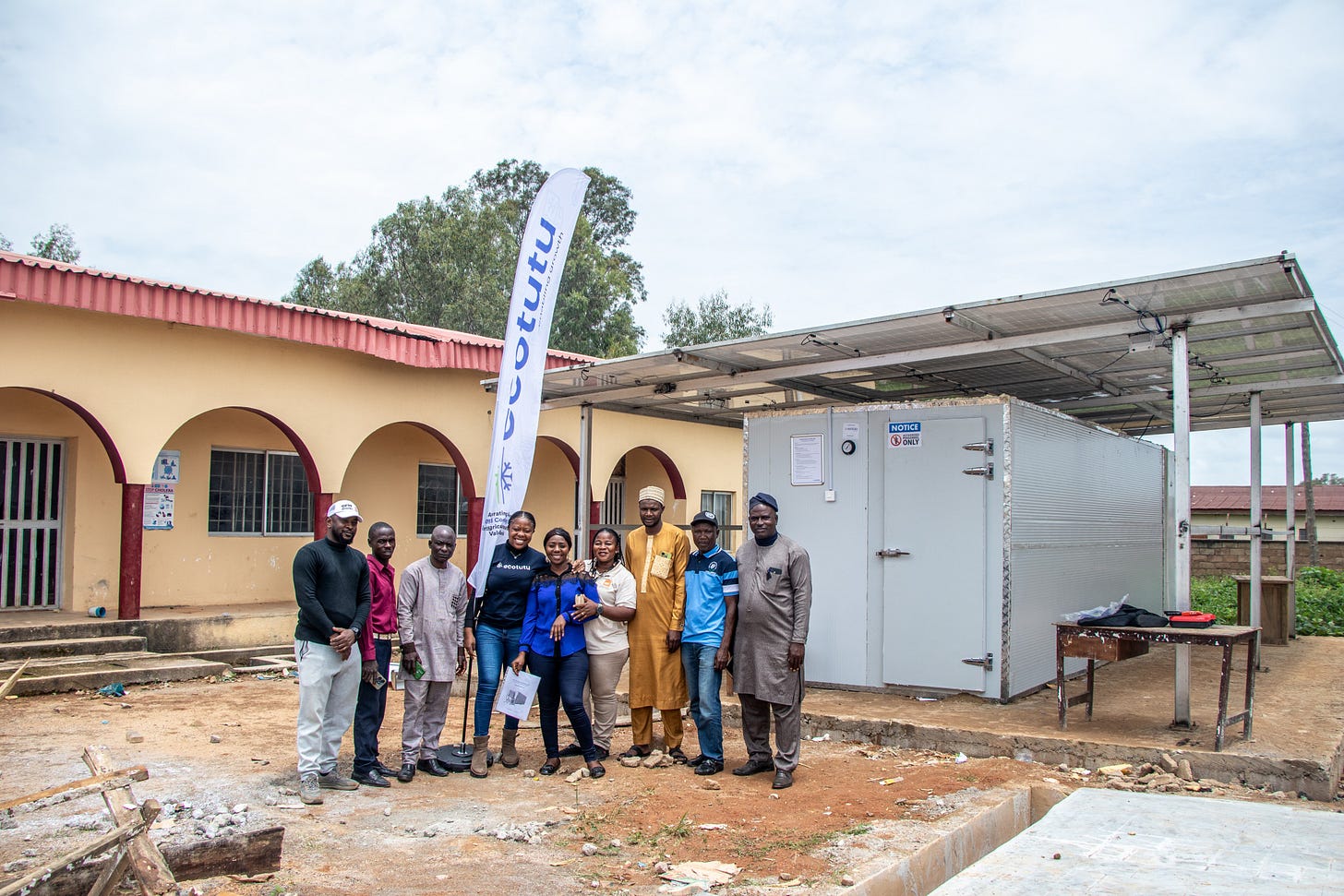
Each Ecotutu Hub is a solar-powered, IoT-enabled walk-in cold room with 10-tonne capacity. A 13kWh solar array powers the system; phase-change materials act as an ice battery, maintaining stable temperatures even during outages or cloudy days. Farmers and traders pay 250 Naira per crate per day, roughly $0.20, with no upfront capital commitment and no long-term contract. Produce that would spoil within two days without storage stays fresh for significantly longer, giving farmers control over when and where they sell.
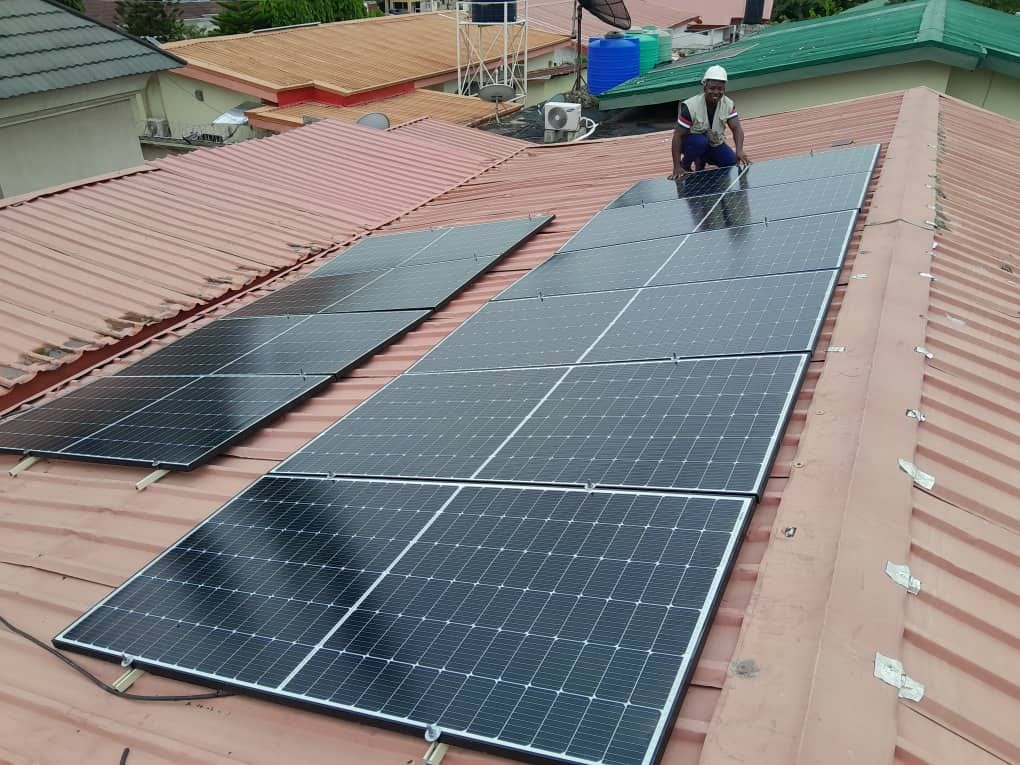
The timing is no accident. Nigeria’s diesel subsidy removal has made conventional refrigeration prohibitively expensive – diesel costs over 1,050 Naira per litre. Grid blackouts lasting days are routine across the country. Solar-powered cooling is no longer just the sustainable option; it is increasingly the only viable one.
Beyond the flagship hubs, Ecotutu has built a full cold chain product suite: refrigerated transport (Ecotutu Express), solar dairy chillers (Ecotutu Dairy), lease-to-own solar freezers for micro-businesses (Ecotutu Chest), and portable cooler bags with reusable ice packs for last-mile distribution. Everything is designed, assembled, and manufactured in Nigeria, with specialist cooling components sourced from German partner SelfChill.
Institutional validation is growing. Partners include HortiNigeria (Dutch-funded), the Lagos State Ministry of Agriculture, Rocky Mountain Institute, GIZ, and Husk Power Systems. Each hub reaches payback in 12 to 18 months, a return profile that is increasingly attracting development finance institutions and impact investors to the space.
The impact data is equally compelling. Users of Ecotutu facilities see up to a 60% reduction in spoilage and a 40% increase in income. Kehinde, a tomato trader at Lagos’s Mile-12 Market, reduced her post-harvest loss by almost 100% and grew her income by nearly 40% after joining the platform, and has since expanded her supply volume through Ecotutu’s market linkage support.
Five years in, the numbers are hard to ignore. Ecotutu has deployed 25 solar cold rooms across 8 Nigerian states, saved over 35,000 tonnes of perishable food from spoilage, mitigated 41,000+ metric tonnes of GHG emissions, and served more than 4,800 farmers, traders, and aggregators – raising their average incomes by around 30%. All of this on $450,000 in combined grant and debt funding.
GT sat down with Babajide to understand how he built a climate hardware company in one of the world’s most challenging environments, and why the cold chain may be the most undercapitalised climate opportunity on the continent.
IN CONVERSATION WITH BABAJIDE OLUWASE
Let’s talk about your capital & investor reality
What do investors consistently misunderstand about Ecotutu?
“The biggest misconception is that hardware in Africa can’t be capital-efficient. People hear ‘climate hardware startup in Nigeria’ and assume high capex, long timelines, and unpredictable returns. The reality is that our payback per hub is 12 to 18 months. Our infrastructure is modular and scalable. And the demand is not speculative, it is structural. We are not creating a market; we are serving one that has existed for decades with almost zero adequate supply. Once investors understand the unit economics and see the utilisation data, the conversation changes completely.”
What makes Ecotutu genuinely investable right now?
“Three things. Proven hardware at scale – 25 deployed hubs across 8 states, not a pilot. A demonstrated business model with real customers paying real money. And a macro tailwind that is only accelerating: diesel costs have surged, grid reliability has worsened, and climate stress is intensifying heat across the region. The window for solar cold chain infrastructure has never been wider. We are not asking investors to believe in a future market. We are asking them to back a working solution into an already-failing system.”
What would you do differently if raising today?
“Seek blended finance structures earlier. The combination of grant capital for hardware development and debt for deployment is a proven model in off-grid energy – we applied it to cold chain with good results, but it took time to find the right partners. I’d also have invested earlier in quantifying our impact metrics rigorously. Impact-aligned capital responds to data. The story was always strong; the numbers just needed to be told more systematically from day one.”
Founder playbook
What’s the most common mistake founders make building climate tech in Africa?
“Building for the investor rather than the user. It is easy to design a product that sounds compelling in a pitch deck but does not survive contact with the reality of your customer’s life. The farmers and traders we serve do not have reliable internet, consistent income flows, or tolerance for complexity. If your product does not work in their context, it does not matter how impressive the technology is. Start with the deepest possible understanding of the problem before you touch a single component.”
What signals tell you a founder has real execution ability?
“Speed of learning, not speed of building. Founders who absorb feedback fast, adapt without losing their core vision, and make decisions with incomplete information, those are the ones who survive. I also look at how they handle their first major failure. The response to adversity tells you more about a founder than any pitch deck ever will.”
If a founder had 60 seconds to pitch you, what should they say?
“Tell me who is suffering from this problem right now, how many of them there are, why existing solutions have failed them, and what your non-obvious insight is that nobody else has acted on. That is it. If you can say all of that clearly in 60 seconds, I know you understand your market. Everything else, technology, team, financials, I can dig into. But without that foundation, no amount of polish will save you.”
Rapid-fire
Your mantra?
Be stubborn on vision, flexible on the details.
Daily ritual that keeps you going?
Time outdoors — it gives me space to reflect on why we started.
Source of optimism?
The farmers. When I see a market woman who no longer rushes to sell before her produce spoils, that is not a data point. That is the whole reason.
………………………………………if you could teleport yourself to 2035, where would you be?
“Ecotutu’s five-year target is 500+ hubs across West Africa, supporting 100,000 farmers and traders, and a connected, data-driven cold chain network that bridges producers to markets efficiently. Beyond agriculture, the model extends directly to pharmaceutical cold chain, a sector with identical infrastructure gaps and, arguably, even higher human stakes.
As climate change intensifies, renewable-powered cooling will be essential for food security, healthcare, and resilience. We see Ecotutu as part of that global transformation.”
The cold chain is the missing link in a continent-wide food system. Solve it, and you change the economics of smallholder farming across Africa.
Africa’s food future depends on infrastructure that works in the environment that actually exists, unreliable grids, rising temperatures, dispersed rural communities, and farmers who cannot afford to lose a single harvest. Ecotutu is building that infrastructure, one solar hub at a time.
Climate builder moment 🌱
The founders who change the world aren’t the ones who burned the brightest for six months. They’re the ones who were still standing – still sharp, still hungry – five, ten, fifteen years in.
This week, notice what refuels you. A walk. A conversation that has nothing to do with your pitch deck. Whatever it is, protect it. That’s not time away from the mission. That’s how you stay capable of serving it.
The world needs your vision intact.